


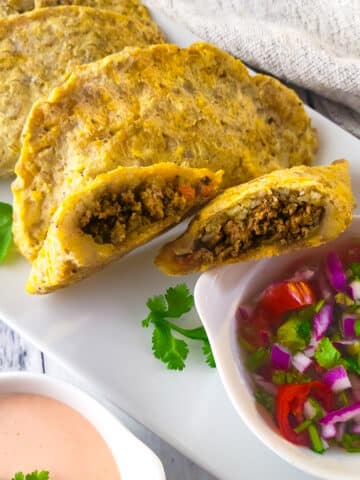
Learn how to make authentic Puerto Rican Alcapurrias at home! These crispy fritters, filled with savory carne molida (picadillo) make a tasty snack that will definitely become a favorite in your home!

Alcapurrias, are one of Puerto Rico’s most popular and favorite street foods enjoyed by locals and visitors alike. Commonly sold from roadside kiosks, these are truly a favorite treat enjoyed throughout the island and much easier to make at home than you might think!
Jump to:
What are Alcapurrias?
Puerto Rican alcapurrias, or “alcapurrias puertorriqueñas” are crispy fried fritters commonly filled with a savory picadillo filling but are also commonly filled with stewed crabmeat (cangrejo), pernil (roast pork shoulder roast) and corned beef.
Traditionally, alcapurrias are made with a dough of green bananas and yautia, giving them their distinctive flavor and texture. Thankfully, this iconic dish is versatile, offering variations to suit different tastes and ingredient availability. For those of us who may not have easy access to certain root vegetables, alternative recipes come to the rescue!
Some blends use green bananas, green plantains, and yuca, while others simplify things by solely using green bananas. Other variations of alcapurrias are made using just yuca (cassava), known as alcapurrias de yuca.
For this recipe, we will be using a blend of green bananas, green plantain, and yuca. This combination is authentic, delicious and produces irresistible alcapurrias!
Reasons to Love this Recipe
- Authentic – This recipe is another authentic Puerto Rican version of the classic.
- Filling – Although I am using the classic beef filling, you can customize the filling to suit your taste.
- Entertaining – This recipe is perfect for entertaining with family and friends. A treat they will most certainly love!
- Freezer Friendly – These fritters are perfect for making ahead and storing in the freezer. That way, whenever you’re in the mood or unexpected guests arrive, you’ll have a comforting and delicious treat or appetizer ready to cook straight from frozen!
- Puerto Rico at Home – Easily recreate this popular street food at home without any complicated steps.
Ingredients

- Green Cooking Bananas – Green cooking bananas are bananas that haven't been “gassed” to induce ripening.
- Frozen Yuca – Use fresh or frozen yuca for this recipe.
- Green Plantain – Do not use ripen plantain as it will not work in this recipe, it must be a green plantain.
- Sazón – Use sazón to season the masa and give it color. You can also use achiote oil (annatto oil) to give the masa color.
*See my recipe card below for a complete list of the ingredients with measurements and instructions.*
Substitutions and Variations
Dough:
- Masa (Dough) – If you cannot find green cooking bananas, substitute a mix of green plantains and yuca for a similar taste.
- Grated Yuca – For a quicker version, use just yuca for the dough.
Fillings:
- Picadillo – Swap the classic beef filling with turkey or chicken ground meat for different taste and light version.
- Crabmeat – To make a delicious crab filling, simply use the same ingredients as the beef filling but substitute the ground beef with crabmeat.
- Vegetarian – Use sauteed mushrooms or roasted vegetables for a vegetarian friendly filling.
Instructions
Carne Molida (Puerto Rican Picadillo) Filling

Step 1: Start by adding the ground meat to a skillet over medium heat (Image 1). Use a spoon or spatula to break it apart as it cooks (Image 2).
Step 2: Add the peppers, onions, sofrito, garlic, sazon, oregano, cumin, and vinegar, stirring well to combine (Image 3).
Step 3: Reduce the heat, cover, and cook for 10 minutes.
Step 4: After ten minutes, add the tomato sauce, olives, water, and cilantro. Stir to combine, then cover and cook for an additional 15 minutes. Taste and adjust the salt as needed. The carne molida is done (Image 4). Set the filling aside to cool while you prepare the masa.
Preparing the Masa

Step 1: Cut about 2-inches off the ends of the green cooking bananas and plantain (Image 1). Using a knife, make a shallow slit down the length of the plantain and bananas. Place the unpeeled bananas and plantain in a pot of hot water for 10 minutes to help loosen the peel (Image 2).
Once softened, slide your thumb or the edge of a knife under the skin to peel. Tip: Peel the skin side to side not lengthwise like you would a regular banana.
To prevent discoloration, place the peeled bananas, plantain and yuca pieces in a bowl of cool water while you prepare the masa (Image 3).
Step 2: Using a food processor with the grating disk attached, start grating a few pieces at a time of the yuca (Image 4) until all the pieces are grated.
Note: If you don’t have a food processor, you can grate all the root vegetables by hand using the finest side of a box grater. It requires a little more effort but achieves the same smooth consistency for the masa.

Step 3: Once all the yuca has been grated, add the sazon and salt (Image 6). Mix thoroughly to evenly season the yuca dough.
Step 4: Transfer the seasoned yuca dough to a separate bowl and set it aside. Next grate the green bananas and plantain (Image 7).
Step 5: Add the grated banana and plantain to the bowl with the yuca dough. Using a spatula or spoon, mix everything together until the masa is smooth and all the ingredients are well combined (Image 8).
Tip: You could also use achiote oil (annatto oil) to color the masa and for seasoning, just add salt or a little adobo.
Forming the Alcapurrias

Step 6: Cut several pieces of wax or parchment paper into 6×6-inch squares or slightly larger to prepare for shaping the alcapurrias.
Step 7: Add a large spoonful of the masa to the center of the paper and flatten it out gently with the back of the spoon to form an even layer of the masa. Add about 2 tablespoons of the cooled filling to the center of the masa (Image 9).
Step 8: Fold the paper over, shaping the masa into a half-moon to encase the filling (Image 10). Gently press the edges to seal. Open the paper to check that the filling is completely covered by the masa. Tip: If any filling is exposed, add a small amount of masa on top and smooth it over to seal completely.
Repeat the process until all the alcapurrias are formed (Image 11).
Frying
Step 9: Add about 2-inches of oil to a large skillet and heat over medium heat for a few minutes until heated through.
Carefully slide one alcapurria at a time into the oil, careful not to overcrowd the skillet, as this will lower the temperature of the oil and result in greasy alcapurrias. Fry for a few minutes on one side until golden brown, then gently flip and fry the other side until equally golden and cooked through. Remove and drain on paper towels before serving. Tip: Enjoy on their own or serve with a side of hot sauce.

How to Freeze Alcapurrias?
- Prepare the Paper: Cut several pieces of wax or parchment paper into 6×6-inch squares.
- Assemble on Paper: Assemble each alcapurria directly on a piece of paper. Shape the dough, add the filling, and fold the alcapurria into a half-moon shape to seal it securely.
- Repeat and Stack: repeat the process until all the alcapurrias are formed. Place them in a freezer-safe plastic bag or airtight container, stacking them neatly with the paper to prevent sticking.
- Freeze: Store the alcapurrias in the freezer for up to 6 months.
- Cook from Frozen: When ready to enjoy, remove as many alcapurrias as you need. Fry them directly from frozen, adding a few extra minutes of cooking time and flipping occassionally to ensure even browning and cooked through.
- Drain and Serve: Once golden and cooked through, drain on paper towels and serve hot. Enjoy!
Expert Tips
- Masa – Make sure to form a good smooth dough to ensure it holds together better when frying.
- Filling – Avoid the temptation to overfill the alcapurrias. Leave enough dough around the edges to seal them properly, which helps to prevent the filling from leaking out during frying.
- Chilling – If you have time, chill the prepared fritters for about 30 minutes before frying. This helps them firm up and hold their shape better while cooking.
- Oil Temperature – Make sure the oil is hot enough before frying. If the oil temperature is too low, the alcapurrias will absorb too much oil and become greasy.
Recipe FAQs
To serve a healthier option, brush them lightly with oil and bake at 375°F (190°C) until golden brown. Flip them over halfway through cooking.
Ensure the dough is well mixed and not too dry. Chilling the assembled alcapurrias for 30 minutes before frying, will also help them hold their shape better.
Yes! Pre-cooked fillings work perfectly. Just make sure the filling is slightly cooled before assembly.
Stored properly in an airtight container or freezer safe bag, alcapurrias can last for up to 6 months and sometimes even longer.
No, there is no need to thaw them. Just add a few extra minutes of cooking time to ensure they are cooked through.
Yes! Add roasted or sauteed vegetables for a vegetarian option.
Other Fried Fritters (Frituras) You Will Love



Did you try this recipe? Please leave a ⭐ review below!
Click any of the images in the post to PIN this Recipe and don't forget to follow along on Pinterest and Facebook.
📖 Recipe

Puerto Rican Alcapurrias
Equipment
- food processor or box grater for grating
- parchment or wax paper cut into 6×6-inch squares
Ingredients
Masa (Dough)
- 5 green cooking bananas peeled
- 1 green plantain peeled
- 1½ lbs frozen or fresh yuca
- 2 teaspoon salt
- 1 packet sazon with achiote (annatto)
Carne Molida (Picadillo)
- 1 lb ground beef
- ½ onion peeled, chopped
- ½ green, red, yellow or orange bell pepper rinsed, chopped
- 2 tablespoon sofrito
- 2 garlic cloves minced or 2 teaspoon puree
- 2 tablespoon pimiento stuffed olives
- 1 packet sazon with annatto
- 4 oz tomato sauce
- ¼ tsp dried oregano
- ⅛ teaspoon cumin
- 1 capful white or cider vinegar
- ¼ cup water
- salt to taste
- handful fresh cilantro
Instructions
Carne Molida (Puerto Rican Picadillo) Filling
- Add the ground beef to a skillet over medium heat. Use a spoon or spatula to break it apart as it cooks.
- Add the peppers, onions, sofrito, garlic, sazon, oregano, cumin, and vinegar, stirring well to combine. Reduce the heat, cover, and cook for 10 minutes.
- After ten minutes, add the tomato sauce, olives, water, and cilantro. Stir to combine, then cover and cook for an additional 15 minutes. Taste and adjust the salt as needed. The carne molida is done. Set the filling aside to cool while you prepare the masa.
Preparing the Masa
- Cut about 2-inches off the ends of the green cooking bananas and plantain. Using a knife, make a shallow slit down the length of the plantain and bananas. Place the unpeeled bananas and plantain in a pot of hot water for 10 minutes to help loosen the peel.
- Once softened, slide your thumb or the edge of a knife under the skin to peel. Tip: Peel the skin side to side not lengthwise like you would a regular banana.To prevent discoloration, place the peeled bananas, plantain and yuca pieces in a bowl of cool water while you prepare the masa.
- Using a food processor with the grating disk attached, start grating a few pieces at a time of the yuca until all the pieces are grated.Note: If you don't have a food processor, you can grate all the root vegetables by hand using the finest side of a box grater. It requires a little more effort but achieves the same smooth consistency for the masa.
- Once all the yuca has been grated, add the sazon and salt. Mix thoroughly to evenly season the yuca dough.
- Transfer the seasoned yuca dough to a separate bowl and set it aside. Next grate the green bananas and plantain.
- Add the grated banana and plantain to the bowl with the yuca dough. Using a spatula or spoon, mix everything together until the masa is smooth and all the ingredients are well combined.
Forming the Alcapurrias
- Cut several pieces of wax or parchment paper into 6×6-inch squares or slightly larger to prepare for shaping the alcapurrias.
- Add a large spoonful of the masa to the center of the paper and flatten it out gently with the back of the spoon to form an even layer of the masa.
- Add about 2 tablespoons of the cooled picadillo filling to the center of the masa.
- Fold the paper over, shaping the masa into a half-moon to encase the filling. Gently press the edges to seal.
- Open the paper to check that the filling is completely covered by the masa. Tip: If any filling is exposed, add a small amount of masa on top and smooth it over to seal completely. Repeat the process until all the alcapurrias are formed.
Frying the Alcapurrias
- Add about 2-inches of oil to a large skillet and heat over medium heat for a few minutes until heated through.
- Carefully slide one alcapurria at a time into the oil, careful not to overcrowd the skillet, as this will lower the temperature of the oil and result in greasy alcapurrias.
- Fry for a few minutes on one side until golden brown, then gently flip and fry the other side until equally golden and cooked through. Remove and drain on paper towels before serving. Enjoy on their own or serve with a side of hot sauce.


Join the Discussion